By Jenna E. White, MA LCPC
Depth Counseling Clinical Supervisor and Director of Clinical Training Program
My mother’s iPhone only recognizes her face when she’s beaming a Broadway-ready, full-teeth smile. Mine? Only if I’m slightly frowning, as though contemplating Nietzsche or trying to remember if I left the stove on. From this alone, you could deduce our vastly different approaches to the holiday season—except for one beloved tradition where we are perfectly in sync.
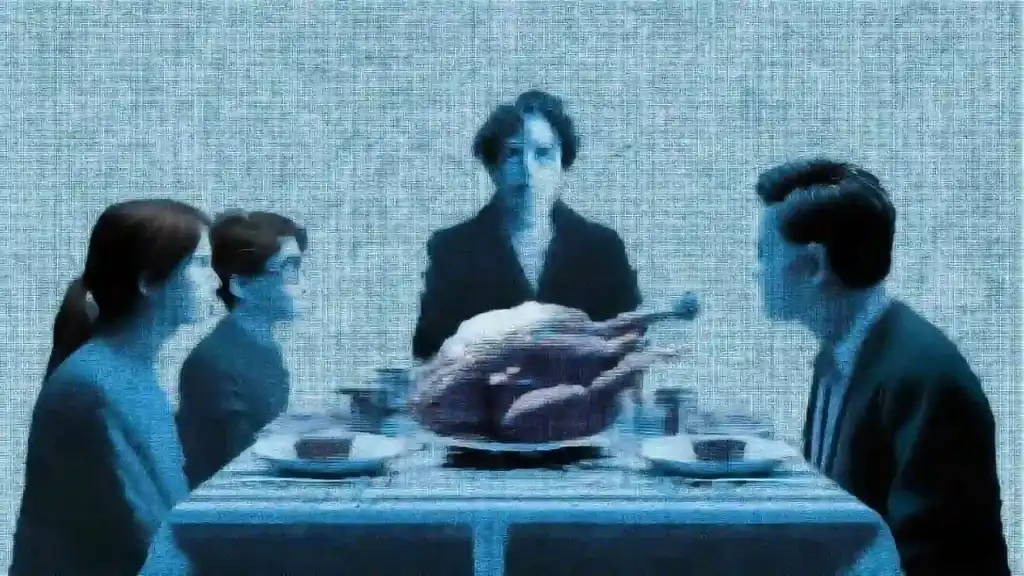
For many, Thanksgiving is a cherished mosaic: family, football, old friends, and a parade of favorite dishes. But for my family, one tradition trumps all others—our annual viewing of Home for the Holidays. Directed by Jodie Foster and starring Holly Hunter, Robert Downey Jr., Anne Bancroft, Claire Danes, and Dylan McDermott, this snarky, 90s dark-yet-sentimental comedy about a wildly dysfunctional family has become our collective litmus test for sanity.
We quote it endlessly—“She flashed me. Aunt Glady flashed me!”—and smugly pat ourselves on the back, reassured that we’re not that unhinged. The truth, of course, is that we are every bit as unhinged, or it wouldn’t still resonate decades later.
“I can see your roots, Claudia.”
The film’s timelessness isn’t just about its sharp humor. It navigates the messy intersections of divergent political views, sibling rivalry, homophobia, loss, second chances, and aging parents with a mix of wit and poignancy that feels unnervingly familiar.
“Enough! You’re a pain in my ass. And you have bad hair. But I like you a lot.”
“Well, you know me. I can’t change.”
“Believe me, Ma. Neither can I.”

Food as the Love Object
Now, let’s talk about the existential wrestling match at the heart of many Thanksgiving tables: food. What was that odd expression on your face in last year’s family photo? Were you pondering life’s mysteries? Nope, you were negotiating with the pecan pie.
Even my ten-year-old niece, a beanpole in sneakers, has absorbed the cultural script: “If you fidget under your desk all day, you can burn 700 calories!” she told me excitedly recently. How many useless calorie “facts” live rent-free in our collective minds?
With Eating Disorders (EDs), food—or its rejection—often morphs into a kind of primary love object. This is what you organize your life around. It’s what whispers in your ear, grabs your attention, seduces, soothes, chastises, and torments you, hijacking hours, days, weeks, years, and countless holidays. You may outwardly seem cheery, engaging in small talk, but internally, it’s just you and your relentless inner critic, calculating clandestine trips to the bathroom or to sneak second, third and fourth helpings. The invisible mile between you and the people who love you becomes an insurmountable gulf.
And just to get this out of the way: Eating disorders are not about vanity. Sure, they may wear a narcissistic veneer, but beneath the surface lie intolerable feelings, attachment wounds, trauma, perfectionism, shame, and discomfort with one’s own mind and body. These are people who have come to equate their own lovability and worth with productivity and rigid esthetic metrics. This is about objectifying oneself. In “The Art of Loving” (1956): Psychoanalyst Erich Fromm emphasized that love requires genuine self-awareness and the ability to share one’s true self. Self-objectification, by contrast, turns individuals into performers seeking validation rather than participants in a mutual, meaningful exchange.

The Minefield of Family Commentary
“Joanne, look at your sister. Doesn’t she look snazzy?”
“Spectacular. New diet?”
Navigating family commentary during Thanksgiving can feel like tiptoeing through a minefield. There’s always someone ready to provide unsolicited opinion on your plate, your body, or someone else’s.
- “I’d kill to wear a size small like you!” (Well, I’m literally killing myself to look this way…)
- “Are you sure you need another helping?” (It took me ten minutes of courage to take this. Now I want to disappear…)
- “I’m so gross and stuffed—time to diet!” (If you’re gross, what does that make me?)
Even self-deprecating comments can feel like indirect blows. Every cruel word about their bodies tattoos itself invisibly onto yours.
When loved ones do know about your ED, the dynamic can shift—but not always for the better. Their well-intentioned surveillance can feel equally isolating, their eagle-eyed glances adding another layer of disconnection. They distrust you because they fear losing you, and you distrust them because they see you as a problem to manage. In the end, no one wins.
“I’m giving thanks that we don’t have to go through this for another year. Except we do, because those bastards went and put Christmas right in the middle, just to punish us.”

The Ten Eleven Commandments for Surviving Thanksgiving: Dodging Diet Culture and Body Shame
1. Thou shalt not bow to thy superego’s tyranny.
Your superego—the inner critic Freud portrayed as a tyrannical buzzkill—will be working overtime. Yet the loudest, meanest voice in your head is rarely the most accurate. In fact, it’s often the LEAST truthful, intelligent, nuanced, grown-up or context-rich perspective. Ignore its guilt-laden diktats as much as possible. When it inevitably pipes up, imagine it in a clown suit or with the voice of Gilbert Gottfried.
2. Thou shalt acknowledge the emotional undercurrent.
Disordered eating often masks deeper feelings. If you catch yourself fixating on food or exercise, step back and get curious. Name the feeling (“Ah, rage at Dad’s passive- aggressiveness!”), and then return to your plate with clarity – and a mental note to tell your therapist.
3. Thou shalt embrace imperfection.
Thanksgiving isn’t a food final exam. If you overeat, under-eat, or stress about eating, remind yourself: perfection is overrated—and the Pilgrims weren’t counting calories either. They were too busy figuring out how to survive, wear uncomfortable buckles, and, you know, colonize an entire continent.
4. Thou shalt deploy defense mechanisms creatively.
- Humor: When Aunt Karen says, “You must be saving calories for dessert!” grin and say, “Nope, saving them for world domination.”
- Intellectualization can come to the rescue when Uncle Bob comments on your weight: monologue about how diet culture is rooted in racism, white supremacy, and colonialism until his eyes glaze over.
- Sublimation: Does Cousin Linda’s keto sermon make you want to hurl stuffing at her? Channel your carb-fueled rage into something less destructive, like aggressively fluffing the couch cushions or calling your local representatives.
5. Thou shalt not let family surveillance define thee.
If your relatives eye your plate like it’s an FBI case file, remember: their discomfort is their problem, not yours. Smile serenely, then pour gravy over your mashed potatoes with the reckless confidence of Banksy spray-painting a government building.
6. Thou shalt manage thy triggers with boundaries.
Boundaries are not about controlling other people’s behavior, they are about managing your own (sorrynotsorry, Jonah Hill). When the table talk turns to calories, cleanse diets, or someone’s cheat day, drop a premeditated “Force Quit” line like:
- “I don’t talk about bodies—mine or anyone else’s.”
- “Pass the stuffing instead of the shame, please.”
- “I’d rather discuss the turkey’s carb intake than mine.”
- If you’re a thespian: “And… Scene!” (dramatic bow optional).
- If you’re a chef: “86, diet talk!” (then flambé something for effect).
- If you’re feeling spicy: “This conversation pairs beautifully with literally anything else.”
Punctuate it with action: leave the room, clear dishes, walk the dog, join the kids’ table, or go home early. The words and the actions don’t have to be drama-filled, but they should be decisive.
7. Thou shalt psychoanalyze them all.
Remember that everyone else is neurotic too, and try to take comfort in the collective dysfunction – it’s practically tradition. One way to do this is to turn the holiday into a case study. Notice Uncle Bob’s passive-aggressive jabs and cousin Debbie’s overcompensatory meddling as defense mechanisms. Remember: it’s projection, not personal. Or maybe it is. Either way, it is fascinating.
8. Thou shalt be mindful-ish
Yes, mindfulness is nice, but hyper-awareness of every chew can feel like a Kafkaesque nightmare. Instead, aim for manageable moments: savor a bite, feel your fork in hand, then dissociate briefly to survive cousin Larry’s rant about the economy.
9. Thou shalt practice radical ambiguity.
EDs thrive on black-and-white rigid thinking. Experiment with curiosity and nuance; even saying to yourself a simple, “Maybe, maybe not” can help. Or channel Doris Day and launch into a full-throated rendition of “Perhaps, Perhaps, Perhaps.”
10. Thou shalt not moralize food.
If Uncle Lester asks, “Are you being good today?” reply, “I wasn’t aware dinner was a moral test, but pass me the butter.” Food isn’t sin or salvation; it’s just food. And morality is a construct, anyway.
11. Thou shalt plan for the post-mortem.
Thanksgiving doesn’t end when the dishes are cleared—it lingers in your psyche. Plan ahead for the fallout: a hot bath, some retail therapy, a comforting movie (Home for the Holidays, anyone?). If these sound like self-care drivel, schedule an extra session with your shrink the following week, have your ride-or-die friend on call, and have resources on hand (like National Eating Disorders Association.)

For someone navigating disordered eating, the true measure of Thanksgiving isn’t your calorie intake; it’s how much emotional damage you managed to avoid. Thanksgiving doesn’t have to be perfect to be meaningful. It’s okay to laugh, cry, struggle, and, yes, even scowl in the family photos. It’s even okay if this year it isn’t all that meaningful, it’s just okay. Good enough is a world better than further harming yourself and setting yourself back.
The British Journalist Johann Hari says that “The opposite of addiction is connection.” Disordered eating is fraught with addictive and compulsive thoughts and behaviors, and often leads to tremendous isolation. This holiday season, try to prioritize a sense of connection, intimacy, and vulnerability with safe people that have earned your openness. And as Freud might have said if he’d faced Aunt Suzy: “Sometimes a plate of stuffing is just stuffing. And sometimes it’s an act of rebellion.”
Suggested Media
- Movie to watch: Home for the Holidays!
- Book to read: “Group: How One Therapist and a Circle of Strangers Saved My Life” by Christie Tate (a memoir about a bulimic woman in group therapy)
- Podcast to listen to: Lives of the Unconscious, Episode 29: The Anorexic Dynamic: or why eating disorders are not about the food